
Agents can find your stores
📍 Shopify added store location search for AI shopping agents, so local availability data now decides whether an agent sends shoppers to your shelf, Media buyer index of the week, and more!


Howdy readers 🥰

In this newsletter, you’ll find:
📍 Get your store locations ready for AI shopping agents in six steps
📊 TikTok and YouTube are the only channels where costs and returns aligned heading into November
🏆 Ad of the Day
If you’re new to ScaleUP, then a hearty welcome! You and 50k+ CEOs, CMOS, and marketers have reached the right place. Let’s get into it, shall we? Oh! Before you forget, if someone forwarded this newsletter to you, don't forget to subscribe to our newsletter so you never miss out!
Together with AirOps
See how competitors are selling inside ChatGPT
You probably know what competitors say on their websites. But what message are they putting in front of people asking ChatGPT for help?
Seeing their pitch can help you decide how to position your own offer.
The AirOps ChatGPT Ad Library lets you search by brand name or domain to see competitor ad messaging and the prompts where those ads appeared. With 6,000+ brands listed, there’s plenty to explore before you write your own brief.
See how a competitor positions its offer in a specific conversation. Then consider what would make yours worth a click.
Use what you find to choose a stronger messaging angle and give your team a concrete reason to test it.
Before you spend on your first test, see how competitors are making their pitch.
📍 Get your store locations ready for AI shopping agents in six steps
Picture a shopper asking an assistant, "Where can I pick up this jacket in a medium today?" As of late October, that assistant can check your stores directly.
On October 22, Shopify added location tools to its Universal Commerce Protocol. Agents can search and look up a merchant's locations, returning up to 250 results with availability for up to 10 product variants at each. The tools don't infer location from IP addresses, and Shopify lists them as provisional.
The agent will repeat whatever your data says. Here's how to make sure it's right.
Step 1: Audit location records
Export every location in your admin. Check address, hours, phone and pickup settings. Enter holiday hours now, before the agent sends someone to a locked door on December 26.
Step 2: Test inventory accuracy
Pick 10 products and compare system stock with a physical count at two locations. If 3 of 10 are wrong, that's a 30% error rate the agent will pass along. That example is illustrative. Anything above about 5% is worth fixing first, in my judgment.
Step 3: Set a safety buffer
If a store shows 2 units and one sells at the counter, the agent's shopper arrives to nothing. Hide the last one or two units from pickup on fast sellers.
Size it with sales speed: a product selling 8 units a day per store sells one every three hours or so in a 10-hour day. A buffer of 2 covers roughly six hours. Slower products need less.
Step 4: Switch pickup off where it can't cope
If a location can't handle pickup volume in peak weeks, turn pickup off there. A missing option costs less than a failed pickup.
Step 5: Brief store staff
Some customers will arrive saying an assistant told them the item was in stock. Give staff a script for when it isn't: offer the nearest store with stock, or ship-to-home with a small credit.
Step 6: Watch the source
Track pickup orders by source, along with no-shows and cancellations. Agent-driven visits may show up as new referrers. Compare the numbers before and after the change.
Why act on a provisional feature
Expect the tools to change. Accurate hours, stock and pickup settings help every customer, agent or not, so none of this work goes to waste.
This week
Run Steps 1 and 2 at your two busiest locations. Wrong hours and wrong stock are what an agent exposes first.
📊 TikTok and YouTube are the only channels where costs and returns aligned heading into November
The final week of October delivered a split that matters heading into peak season, click costs moved in opposite directions across major platforms while conversion rates fractured, separating the channels worth scaling into November from those quietly bleeding margin.
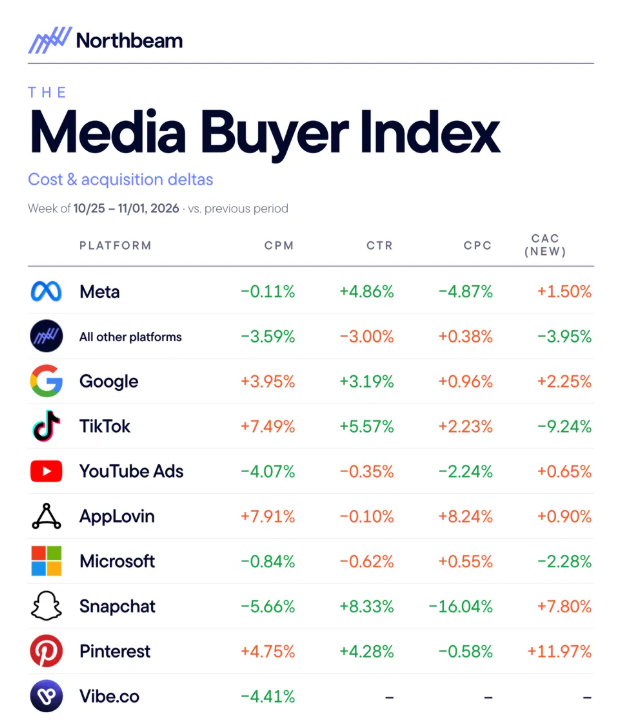
The Breakdown:
CPC - Meta and YouTube saw click costs fall while Snapchat, Google, and Pinterest held flat or pushed higher. Where CPCs dropped alongside positive ROAS, lock in current audience segments now before Black Friday auction pressure absorbs the efficiency window.
CAC - TikTok (-9.24%) and Microsoft (-2.28%) improved while Meta, Google, Snapchat, and Pinterest all worsened sharply. Snapchat’s +7.80% CAC spike alongside -21.44% CvR collapse makes it an immediate pause; pull that budget before it compounds further into peak.
ROAS - YouTube led at +7.37% and Microsoft posted +8.85%, while Pinterest (-11.57%) and Google (-1.58%) declined. Microsoft at 0.84% share with the second-best ROAS on the board, is the most underleveraged channel heading into Black Friday, open a test budget now.
Meta holds 55.25% of spend with +1.54% ROAS but -5.05% CvR, clicks are cheaper, but fewer are converting, which is the wrong direction to be moving in the week before peak season. YouTube at 2.90% posted +7.37% ROAS and TikTok at 4.53% posted +12.95% CvR simultaneously.
Increase both heading into Black Friday, cut Pinterest and Snapchat immediately, and treat Microsoft’s +8.85% ROAS as the highest-upside underallocation on the board right now.
Together with Omnisend
Imagine beating a month’s email revenue with one send
You’d probably double-check the numbers.
Enflow Digital did exactly that for a skincare client ahead of BFCM. One plain-text email sent through Omnisend to 1,676 recipients generated nearly $18,000, beating the previous month’s broad-audience campaigns combined.
Omnisend helped the team find the right customers to send it to. Its segmentation and MCP capabilities let them uncover purchase patterns in minutes.
Co-founder Karolina shares how they pulled it off with Omnisend, from choosing the audience to making the offer worth opening. Worth a read (or a watch) before you hit send on your own BFCM campaigns.
New to Omnisend? It's an email and SMS marketing platform for ecommerce used by more than 150,000 brands, generating an average of $79 for every $1 spent. Migration is free and takes up to five business days.
🎥 Ad of the Day
What Works:
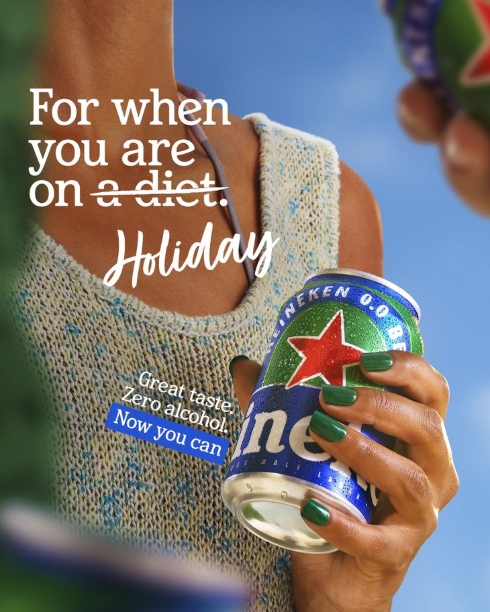
Hook Reframes Occasion - “For when you are on a diet… Holiday” uses a playful correction to create a pattern interrupt, reframing zero-alcohol beer around enjoyment instead of restriction.
Lifestyle Feels Natural - The relaxed vacation styling, sunlight and casual can-in-hand moment make the product feel native to leisure occasions, strengthening message-market fit for sober-curious consumers.
Product Stays Hero - The chilled can dominates the foreground, giving strong branding recall while the green nails and bright sky add visual contrast without competing with the pack.
Take a category compromise like “zero alcohol” and position it around freedom, occasions and lifestyle. This makes the alternative feel additive rather than like giving something up.
Advertise with Us
Wanna put out your message in front of over 50,000 best marketers and decision makers?
We are concerned about everything DTC and its winning strategies. If you liked what you read, why not join the 50k+ marketers from 13k+ DTC brands who have already subscribed? Just follow this.
At ScaleUP, we care about our readers and want to provide the best possible experience. That's why we always look for ways to improve our content and connect with our audience. If you'd like to stay in touch, be sure to follow us EVERYWHERE🥰
Thanks for your support :) We'll be back again with more such content 🥳