
The Intent Mismatch Story
🧐Why good traffic still converts poorly, Media buyer index of the week, and more!


Howdy readers 🥰
In this newsletter, you’ll find:
🧐The Intent Mismatch Story
📉 Paid media got more expensive, while returns got pickier
🏆 Ad of the Day
If you’re new to ScaleUP, then a hearty welcome! You and 50k+ CEOs, CMOS, and marketers have reached the right place. Let’s get into it, shall we? Oh! Before you forget, if someone forwarded this newsletter to you, don't forget to subscribe to our newsletter so you never miss out!
Together with Levanta
Find the Revenue You’re Missing. Lunch Included.
Most marketplace sellers run affiliates because they’re supposed to.
At month end, almost no one can answer one question: what actually made us money.
Creators drive traffic, marketplaces capture the sale, and you’re left guessing which efforts actually paid off.
Levanta fixes it by turning affiliates into a real performance channel across Amazon and Walmart. You see exactly which creators drove sales, which marketplace converted, and what’s worth scaling again.
With Levanta, sellers can:
- Partner with 50,000+ vetted creators and affiliates
- Track clicks, sales, and ROI with clear analytics
- Amplify what works and stop paying for what doesn’t
- Manage creators, commissions, and payouts across marketplaces with ease
Over 3,000+ marketplace brands use Levanta to drive 274% sales lift, 3× ROAS, and over 73% of sales attributed directly to affiliates.
After that, decisions get obvious. You stop guessing and start scaling with proof.
Qualified sellers who book a demo will receive a $75 Uber Eats or DoorDash gift card. Eligibility confirmed after booking.
🧐The Intent Mismatch Story
Most landing pages don’t fail because they’re slow, ugly, or confusing.
They fail because they’re trying to answer too many questions at once.
Traffic arrives with intent. Not interest. Not curiosity. Intent. And intent is specific. It’s shaped by the query, the ad, the promise, and the mental state of the person who clicked.
The moment that intent hits a page that isn’t designed for it, conversion collapses.
The common mistake is treating landing pages like destinations instead of filters.
One page. One flow. One narrative meant to work for everyone.
But traffic isn’t uniform. Some visitors are ready to buy. Some are comparing. Some want reassurance. Some want proof. Some are trying to decide if this even applies to them.
When a single page tries to serve all of those states, it ends up matching none of them particularly well.
This mismatch creates a chain reaction that most teams miss.
When intent isn’t matched, users hesitate. Hesitation increases dwell time without progress. That behavior feeds back into the ad system as weak engagement. Weak engagement reduces delivery. Reduced delivery increases CPC.
By the time conversion rates drop, the auction has already adjusted against you.
This is why landing page quality now affects ad performance before it affects revenue. Intent matching isn’t about personalization gimmicks or endless variants.
It’s about structural clarity.
A page needs to make a fast decision about who it is for and who it is not. The opening message must align with the promise that earned the click. Distractions that serve other intents need to be removed, not accommodated.
This is where many teams lose leverage. Search demand, keyword intent, competitor positioning, and landing page messaging are often planned in isolation. Without seeing how intent is expressed upstream, pages default to broad messaging that feels safe but converts late.
This is where Semrush One comes in. By unifying search intent signals, competitive context, and content alignment in one system, it helps teams identify which intents are actually being paid for and whether landing pages are built to resolve them quickly.
Pages stop trying to cover everything and start resolving the right thing. You can start your 7-Day free trial now!
This also changes how pages should be evaluated.
Instead of asking, “Does this page convert well overall,” the better question is, “Which intent does this page convert best?”
If you can’t answer that, you’re likely sending mixed traffic into a single flow and hoping averages work out.
They won’t.
As ad platforms tighten delivery around engagement and experience signals, intent mismatch becomes expensive faster.
Better ads can’t fix it. More traffic amplifies it. Optimization downstream won’t save it.
The fix is upstream.
Match the page to the intent that earned the click. Design for resolution, not coverage.
Because the real cost of a bad landing page isn’t lost conversions. It’s paying more for traffic that never had a chance to work.
📉 Paid media got more expensive, while returns got pickier
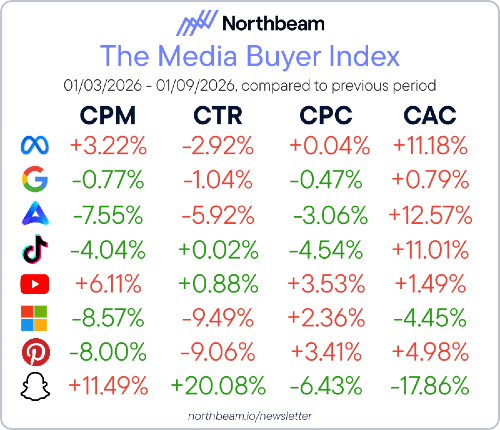
Last week looked like a classic efficiency squeeze. Some channels got cheaper to buy, but conversions and payback did not follow. That gap is forcing teams to protect margin, tighten targeting, and re-earn scale with better offer and landing page alignment.
The Breakdown:
CPC - Costs rose on Meta, YouTube, Microsoft, and Pinterest. Costs fell on Google, Amazon, TikTok, and Snapchat. If you are leaning on the rising-cost channels, expect more pressure to refresh creatives faster and control waste with tighter audience and placement rules.
CAC - CAC rose on Meta, Google, Amazon, TikTok, YouTube, and Pinterest. CAC fell on Microsoft and Snapchat, signaling weaker conversion quality in the biggest reach channels, so teams should prioritize post-click fixes and re-test value props before scaling spend.
ROAS - YouTube led with +16.50 percent ROAS, with Snapchat also up +5.29 percent. Meta, Amazon, TikTok, Google, Pinterest, and Microsoft all lagged, with Amazon down -18.06 percent. Scale belongs to channels where returns improved, not where clicks got cheaper.
Budgets stayed concentrated, with Meta holding a 65.68 percent share while performance weakened. The biggest spend expansion was YouTube at +23.70 percent share change, while Snapchat pulled back sharply at -23.65 percent. Rebalance by protecting winners, and isolate losers into smaller test lanes until ROAS stabilizes.
🎥 Ad of the Day

What Works:
1. Core Trigger: This turns a boring task into identity. A domain is framed like claiming your name, not buying a product, which makes the action feel personal and overdue.
2. Why The Copy Works: “Your name deserves a home” feels warm and human, not technical. It reframes the domain as ownership and legitimacy, not a checkbox for entrepreneurs.
3. Funnel Job: This is an activation ad. It’s designed to get first-time builders moving, because once someone claims a domain, they’re way more likely to finish the site.
If your product has friction, sell the first step, not the full journey. Make the starting line feel fast, simple, and emotionally rewarding.
Advertise with Us
Wanna put out your message in front of over 50,000 best marketers and decision makers?
We are concerned about everything DTC and its winning strategies. If you liked what you read, why not join the 50k+ marketers from 13k+ DTC brands who have already subscribed? Just follow this.
At ScaleUP, we care about our readers and want to provide the best possible experience. That's why we always look for ways to improve our content and connect with our audience. If you'd like to stay in touch, be sure to follow us EVERYWHERE🥰
Thanks for your support :) We'll be back again with more such content 🥳