
Your wrong pages got indexed
🔪 Google is splitting your authority between two versions of you, Media buyer index of the week, and more!


Howdy readers 🥰
In this newsletter, you’ll find:
🔪Your wrong pages got indexed
📊 Click Costs Are Falling on the Biggest Platforms, But Returns Are Not Following
🏆 Ad of the Day
If you’re new to ScaleUP, then a hearty welcome! You and 50k+ CEOs, CMOS, and marketers have reached the right place. Let’s get into it, shall we? Oh! Before you forget, if someone forwarded this newsletter to you, don't forget to subscribe to our newsletter so you never miss out!
Together with Funnelish
90% more conversions. Same product. Different funnel.
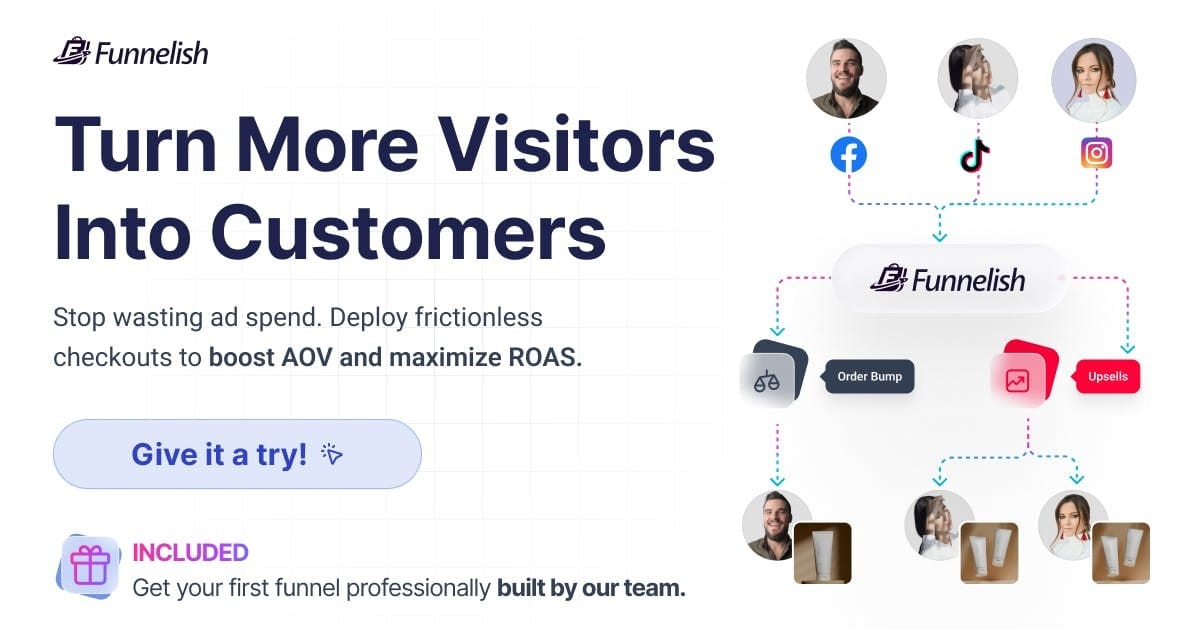
Liquid Death didn't reformulate the water. They rebuilt what happened after the click, and the conversion rate jumped 90%. That's not a marketing story. That's a funnel story.
Most brands optimize the ad and ignore the rest. Pages drag. Checkouts leak. Abandoned carts go quiet. The revenue disappears before it ever lands.
Funnelish is built for everything the ad can't fix. And if you're already running a funnel somewhere else, their team will migrate it for you, free.
- Sub-1-second load times. Half of your traffic won't wait longer than 3 seconds
- Drag-and-drop builder covering every stage: landing pages, upsells, cart recovery, confirmation
- 70% of visitors abandon cart. Built-in email and SMS sequences pull them back
- Shopify, Stripe, Klarna, Google Sheets, Facebook Pixel, and 27+ integrations total
$2B+ processed. 33 million purchases. 4,600+ users who stopped patching and started scaling.
The traffic is already there. The funnel just needs to do its job.
Start free for 14 days. No card needed.
🔪Your wrong pages got indexed
A silent ranking killer sits inside most dev workflows, and nobody checks it until the damage is already done.
When a staging environment goes live without proper crawl controls, search engines don't distinguish between it and the production site. They index both. They see near-duplicate content across two URLs and split their signals accordingly.
The live site stops consolidating authority the way it should. Rankings soften. Traffic slides. And because nothing visibly broke, nobody connects the drop to the staging environment that's been quietly competing with every page that's supposed to rank.
This isn't an edge case. It's one of the most common self-inflicted SEO problems in existence.
How the exposure happens.
Staging environments get spun up fast under deadline pressure. Search visibility isn't part of the checklist because the assumption is that Google won't find it. That assumption fails more often than teams realize:
- A sitemap left publicly accessible on the staging subdomain
- A single crawlable external link placed during QA
- A robots.txt that never got updated after the environment was cloned from production
Any one of these is enough. Once Google finds and indexes staging URLs, the duplicate content problem is already running in the background regardless of how well everything else is optimized.
The three controls that should be non-negotiable.
Every staging environment needs all three simultaneously, not one or two:
- Server-level access restriction. Password protection or IP allowlisting is the only reliable solution. Robots.txt can be ignored by crawlers and provides no real barrier.
- No-index meta tags on every staging page. A secondary layer for anything that slips past server restrictions.
- Zero staging URLs in Google Search Console. If they're appearing there, they're already indexed and need active removal requests, not passive waiting.
For staging URLs already in the index, submit removal requests through Search Console immediately and implement no-index tags while deindexing processes. Google doesn't drop them quickly on its own.
The wider visibility problem this points to.
A staging environment leaking into the index is a crawl hygiene issue. But the brands losing ground in 2026 often have a deeper problem: they don't know how they're appearing across AI search platforms at all.
SEMrush AI Visibility tracks exactly this, monitoring how often your brand appears in AI responses across ChatGPT and Google AI Mode, measuring share of voice against competitors, identifying the prompts and sources where competitors are cited while you aren't, and flagging site-level issues that reduce AI search presence. You can try it for free for 7 days.
Fix the staging environment first. Then find out what AI search actually thinks of what's left.
📊 Click Costs Are Falling on the Biggest Platforms, But Returns Are Not Following
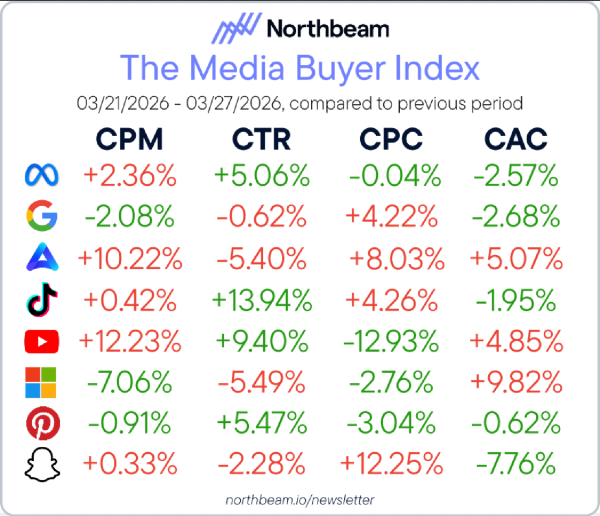
Last week presented a rare setup where impression and click costs moved favorably on several high-volume platforms, yet conversion efficiency and returns deteriorated broadly, a disconnect that makes budget decisions harder, not easier.
The Breakdown:
CPC - Meta, YouTube, Microsoft, and Pinterest saw click costs fall while AppLovin, Google, TikTok, and Snapchat pushed higher, use cheaper inventory on the former to run creative tests, not scale proven campaigns, until CvR confirms the efficiency is real.
CAC - Snapchat, Google, Meta, TikTok, and Pinterest improved while Microsoft, YouTube, and AppLovin worsened, where CAC is improving, increase budget incrementally and track whether gains hold at higher spend, not all at once.
ROAS - Pinterest posted +9.67% while AppLovin (-9.71%), Snapchat (-11.07%), and YouTube (-5.78%) all declined, shift creative energy toward Pinterest and Google, cap spend on declining platforms, and let return data dictate the next budget cycle.
Meta grew share to 65.13% and Microsoft jumped +7.08% despite negative ROAS, while Snapchat shed 20.24% of its share, Pinterest at 0.67% budget share with +9.67% ROAS remains structurally underfunded, and Microsoft's share gain without return improvement is the allocation anomaly most worth scrutinizing this week.
🎥 Ad of the Day
What Works:
The Hidden Conversion Mechanism
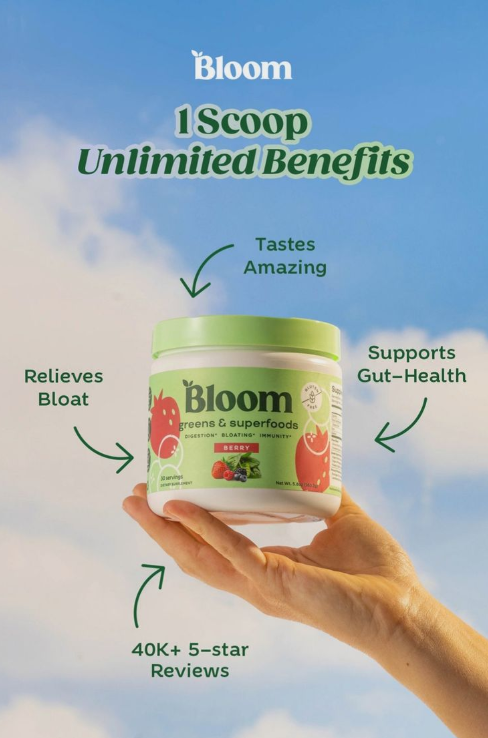
This ad compresses the product into a single daily action with disproportionate payoff. “1 scoop” vs “unlimited benefits” creates an imbalance that feels almost unfair, which makes the offer intuitively attractive without needing proof.
The floating-in-hand visual mimics a presentation moment, like something being offered to you, reducing the distance between the viewer and the product. It feels given, not sold.
The arrows create a guided interpretation path, removing the effort in understanding value.
Shrink the effort to one simple action, then exaggerate the payoff gap so it feels irrational not to try.
Advertise with Us
Wanna put out your message in front of over 50,000 best marketers and decision makers?
We are concerned about everything DTC and its winning strategies. If you liked what you read, why not join the 50k+ marketers from 13k+ DTC brands who have already subscribed? Just follow this.
At ScaleUP, we care about our readers and want to provide the best possible experience. That's why we always look for ways to improve our content and connect with our audience. If you'd like to stay in touch, be sure to follow us EVERYWHERE🥰
Thanks for your support :) We'll be back again with more such content 🥳