
Size your January creative budget
🧮 Creative budgets usually get set by gut feel, so work out how many new ads your spend needs each month and what they'll cost, media buyer index of the week, and more!


Howdy readers 🥰
In this newsletter, you’ll find:
🧮 Five steps to work out how many new ads your January budget needs
🚨 Meta and Google are absorbing more budget while TikTok and YouTube signal where the real returns are
🏆 Ad of the Day
If you’re new to ScaleUP, then a hearty welcome! You and 50k+ CEOs, CMOS, and marketers have reached the right place. Let’s get into it, shall we? Oh! Before you forget, if someone forwarded this newsletter to you, don't forget to subscribe to our newsletter so you never miss out!
Together with AirOps
Could Your Reporting Get the Wrong Channel Cut?
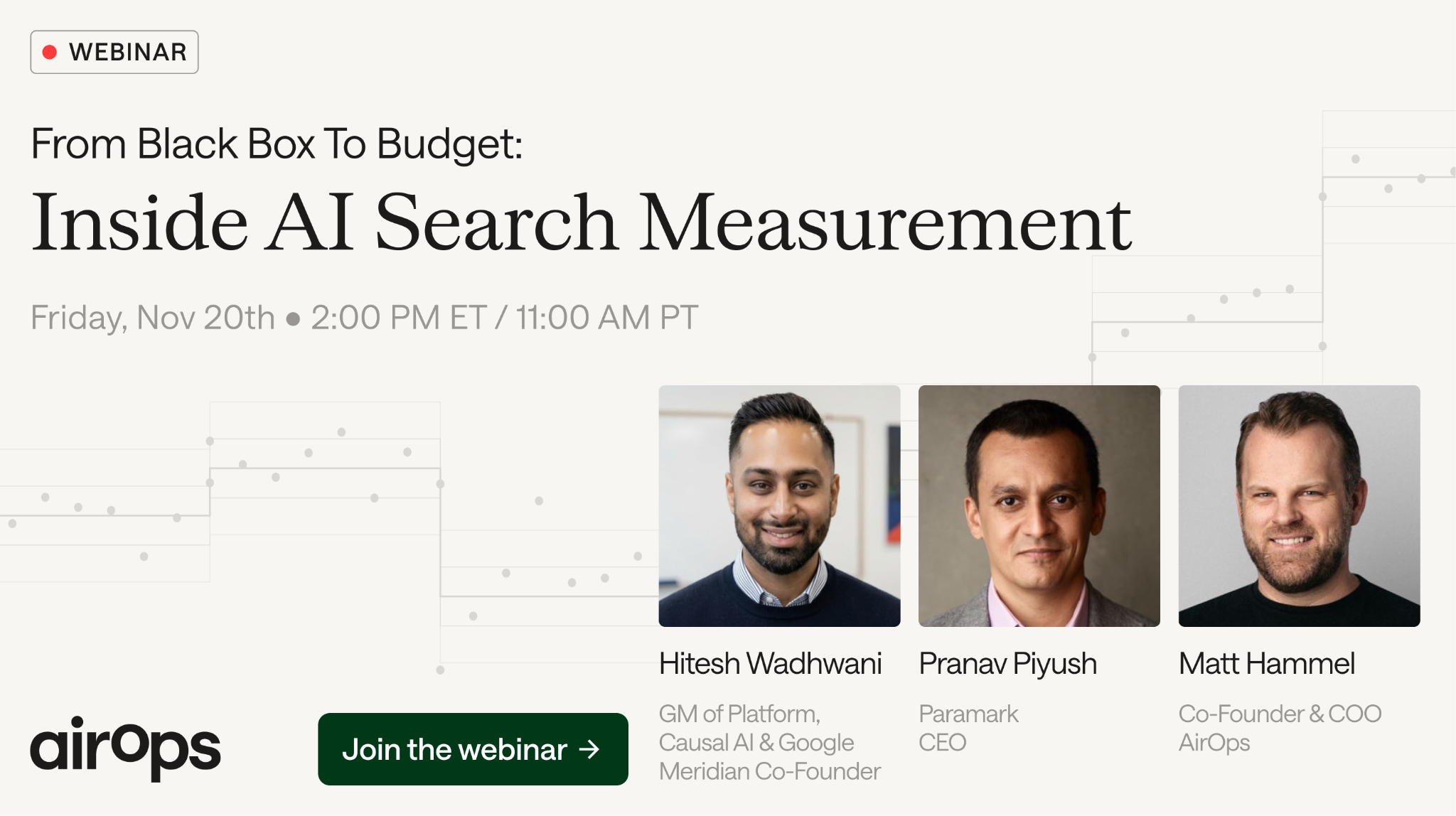
AI search could influence a buyer long before a sale shows up in your reports. If that influence goes uncredited, you could cut spending on a channel that’s helping customers choose you.
On November 20 at 2 PM ET, get inside the measurement work with Google Meridian creator Hitesh Wadhwani, Paramark CEO Pranav Piyush, and AirOps’ COO Matt Hammel.
They’ll break down the blind spots that could be steering your spend:
- Understand where AI search attribution falls short before treating low tracked results as a reason to cut.
- Learn the three requirements for credible measurement so you can spot what your provider’s reporting is missing.
- Explore how AI search fits into existing marketing mix models alongside the channels competing for your budget.
Take the gaps in your reporting back to your team before they become cuts in your budget.
Can't attend the session live? Register anyway, and you’ll get the recordings within 24 hours.
🧮 Five steps to work out how many new ads your January budget needs
When a Meta account stalls, the usual answer is "we need more creative." How much more rarely gets a number, so the production budget gets whatever is left after media. This is sized from your own account data. All numbers are illustrative.
Step 1: Measure how long a winner lasts
Export your top 20 ads by spend from the last six months. For each, count the days from launch until its cost per purchase stayed 30% above its best two-week average. Take the median. Say it's 30 days.
Step 2: Measure what one winner carries
Check how much monthly spend a winner absorbs before cost per purchase drifts past target. Say $15,000. With a January budget of $90,000, you need six winners live at once. With a 30-day lifespan, all six retire each month, so you need about six new winners every month.
Step 3: Find your hit rate
Of every ad you launched in those six months, what share became a winner by the Step 1 standard? Say one in five. Then you need 6 ÷ 0.2 = 30 new ads a month to keep six winners running.
Step 4: Put a price on it
Multiply tests by cost per asset. At $250 an asset, 30 ads cost $7,500, or about 8% of a $90,000 budget. If your actual creative line is 3%, you've found why the account stalled. If you're pricing outside production, Grapevine's fee calculator gives a cost per asset to drop straight into this step. Its creator ads run through the creators' own accounts, and Futurhealth now runs over 40% of its account on them with CPA more than 15% better.
Step 5: Split the 30 by job
Thirty ads shouldn't be thirty versions of one idea. My judgment on a starting split:
- 12 iterations of current winners: new hooks, same body.
- 12 new angles, each with a fresh hook and proof point.
- 6 wild cards: formats or claims you haven't tried.
Track hit rate by bucket for two months, then move ads toward whichever bucket produces more winners.
This week
Run Steps 1 and 3 on your own data. The answer usually explains the stall before any new ad ships. If the number is bigger than your team can make by January, book a free Grapevine demo before November 30, while new kickoffs still get the first campaign free.
🚨 Meta and Google are absorbing more budget while TikTok and YouTube signal where the real returns are
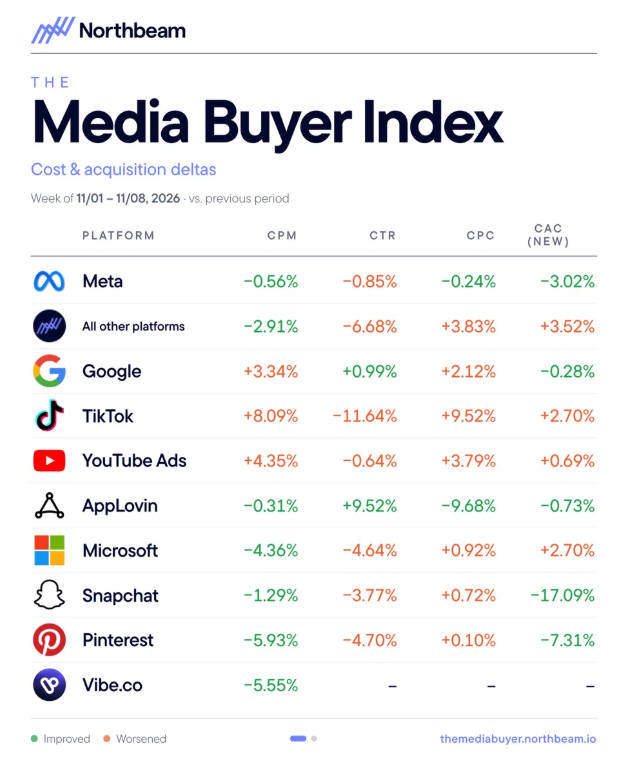
The first full week of November drew a sharp dividing line across the channel landscape; acquisition costs fractured in both directions while conversion rates surged on platforms that remain massively underfunded relative to where the ROAS is actually landing.
The Breakdown:
CPC Meta and Google split hard, with TikTok spiking. Rising CPCs without matching CvR gains signal margin compression, not scale opportunity. Reduce spend on high-CPC channels before Black Friday auction pressure locks in the damage.
CAC Snapchat and Pinterest improved while TikTok, YouTube, and Microsoft all worsened slightly. A CAC drop on a low-volume channel means nothing without full-funnel validation behind it. Audit the conversion path before moving budget toward the apparent winners.
ROAS - Snapchat led at +7.57% and Pinterest at +4.49%, while YouTube slipped -0.50%. Meta’s +3.35% ROAS combined with improving CvR is the more reliable scale signal at proven volume. Open a small test on Snapchat, but wait for a second consecutive week before committing real budget.
Meta holds 56.21% of spend and is earning it this week; ROAS and CvR both improved, making it the one channel where the allocation is justified. TikTok sits at just 4.30% and Google at 17.18%, both posting strong conversion signals relative to their share.
Hold Meta, push incremental budget into TikTok’s CvR momentum, and open a Snapchat test before the ROAS signal gets priced out.
🎥 Ad of the Day
What Works:
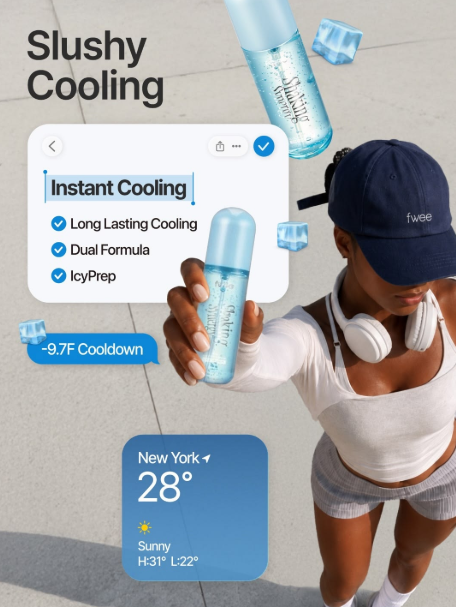
Context Makes Benefit - The hot-weather workout setting makes “instant cooling” immediately relevant, tying the product to a high-intent moment where the benefit feels useful rather than abstract.
UI Builds Credibility - Weather, cooldown and checklist-style overlays make the claim feel measured and specific, adding proof while keeping the creative native to mobile interfaces and easy to scan
Product Stays Visible - The bottle appears both in-hand and as a floating hero shot, strengthening branding recall while the icy blue palette reinforces the cooling promise visually.
When selling a sensory benefit like cooling, warmth or hydration, pair the lifestyle moment with a measurable cue so the claim feels more concrete and believable.
💃Events
🔥 What the Creator of Google Meridian Looks at Before Moving Budget
November 20 | 2 PM ET | Virtual Event
Hitesh Wadhwani, creator of Google Meridian, breaks down how to judge AI search when last-click attribution misses the influence. Learn which exposure signals matter, how recommendations should be valued, and what evidence your team should demand before the next budget review.
Can't attend the session live? Register anyway, and you’ll get the recordings in 24 hours.
Advertise with Us
Wanna put out your message in front of over 50,000 best marketers and decision makers?
We are concerned about everything DTC and its winning strategies. If you liked what you read, why not join the 50k+ marketers from 13k+ DTC brands who have already subscribed? Just follow this.
At ScaleUP, we care about our readers and want to provide the best possible experience. That's why we always look for ways to improve our content and connect with our audience. If you'd like to stay in touch, be sure to follow us EVERYWHERE🥰
Thanks for your support :) We'll be back again with more such content 🥳