
The Gap Between Budget and Process
📈 Most have no plan for the operational chaos that follows a fast budget increase. The system usually doesn't scale with the money, Media Buyer Index of the week, and more!


Howdy readers 🥰

In this newsletter, you’ll find:
📈 87% of Marketers Are Increasing Influencer Budgets. Most Have No Plan for the Chaos That Follows.
📊 Pinterest posted the week's best returns, at a budget share that barely registers
🏆 Ad of the day
If you’re new to ScaleUP, then a hearty welcome! You and 50k+ CEOs, CMOS, and marketers have reached the right place. Let’s get into it, shall we? Oh! Before you forget, if someone forwarded this newsletter to you, don't forget to subscribe to our newsletter so you never miss out!
Together with AirOps
Why your AI visibility keeps disappearing overnight

Only 30% of brands stay visible in an AI answer from one run to the next. Run the same prompt 5 times, and only 20% show up in all 5. That's not a ranking problem.
Rankings barely move day to day. AI visibility does, and most teams are still measuring it with a dashboard built for the old game.
AirOps broke down what's actually driving citations in 2026:
- Freshness compounds. Pages updated in the last 3 months are 3x more likely to get cited.
- Structure matters more than design. Clean heading hierarchy alone lifts citation odds 2.8x.
- Most of it happens off your site. 85% of brand mentions in AI search come from third-party sources, not your domain.
Five metrics replace the old scorecard: citation rate, mention rate, share of voice, sentiment, and source attribution. They need a weekly review, not a quarterly one.
If your GEO (Generative Engine Optimization) strategy still lives inside your SEO report, you're measuring last quarter's game.
Want the full breakdown on where citations come from and how to track them weekly?
📈 87% of marketers are increasing influencer budgets. Most have no plan for the chaos that follows.
Eighty-seven percent of marketers plan to increase their influencer budgets in 2026, and more than 72% of those are planning increases of 50% or more, inside an industry that's already grown to roughly $40 billion globally.
That's not gradual, careful scaling. It's a fast, broad move toward significantly more creator spend across the industry at once, and a budget increase of that size rarely arrives alongside a proportional increase in the process discipline needed to actually manage it well.
The pattern that tends to follow a fast budget increase is predictable: a program built for managing five or twenty creator relationships gets asked to manage two, three, or five times that volume, using the same manual processes, the same informal tracking, the same ad hoc vetting that worked fine at the smaller scale and starts breaking down almost immediately at the larger one.
The budget grew. The system running it usually didn't, at least not at first, and that gap is where a bigger investment quietly starts producing worse results per dollar than the smaller version did.
Audit whether your current process was actually built for the scale your new budget implies
A process that worked managing a dozen creator relationships wasn't necessarily designed with an assumption about what happens at five times that volume, and assuming it scales linearly is usually wrong.
Before deploying a significantly larger budget into more creator relationships, map out specifically where your current process, vetting, briefing, payment, performance tracking, would strain or break at two, three, or five times current volume.
That's the list of what needs to change before the money, not after. Return on Influence Festival '26 covers exactly this scaling challenge on October 21.
Separate the systems problem from the creator-sourcing problem
More budget naturally raises the question of finding more creators, and that's usually the easier half of the challenge compared to the operational systems needed to manage a much larger roster without sliding into informal chaos.
Prioritize building or acquiring the process infrastructure, structured vetting, standardized briefing, centralized performance tracking, before the budget increase lands, rather than discovering the systems gap live, with real money already committed to a roster the current process can't manage.
Learn from teams who've already made this exact jump
Scaling from a handful of creator relationships to a genuinely large roster without multiplying the operational chaos is a specific, learnable skill, powered by Modash and featuring Leah Walker from Adobe, Tyler Vaught from Edelman, and other industry leaders. You can secure your free spot here, with recordings available within 24 hours if you can't attend live.
The budget increase is coming for most programs whether the process is ready or not. The teams that scale well are the ones who fixed the system before the money arrived, not after.
📊 Pinterest posted the week's best returns, at a budget share that barely registers
Last week's environment tightened heading into September; costs climbed on several major platforms while returns deteriorated broadly, making the few channels holding positive signals significantly more valuable than their current budget allocation reflects.
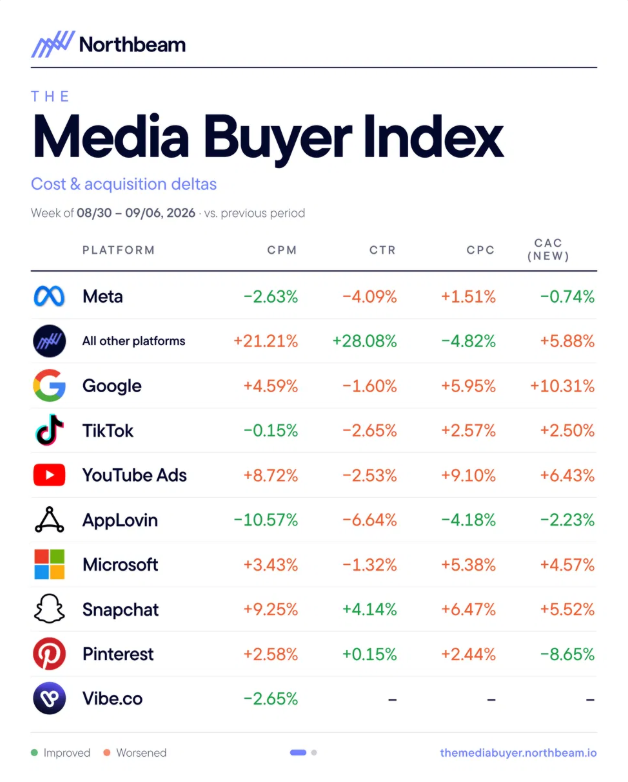
The Breakdown:
CPC - Meta and TikTok saw click costs hold relatively flat while Google, YouTube, Snapchat, and Microsoft all pushed higher, where CPCs rose alongside worsening ROAS, like Google and YouTube; reduce spend now rather than waiting for CAC to confirm the deterioration.
CAC - Meta, Pinterest, and Snapchat improved while Google, YouTube, TikTok, and Microsoft all worsened; Google's +10.31% CAC spike alongside -9.94% ROAS is the week's sharpest combined deterioration; pause any budget increases on Google immediately and audit campaign-level performance.
ROAS - Pinterest led at +15.78%, and Snapchat posted +3.49%, while Google (-9.94%) and YouTube (-7.60%) collapsed, Pinterest, at 0.49% budget share with the strongest return figure on the board, is the most urgent underfunding case heading into the back-to-school spending window.
Meta holds 53.23% of spend with improving CAC but -0.72% ROAS, conversion gains aren't reaching the return line yet, so hold Meta flat rather than scaling into an unconfirmed signal. Pinterest at 0.49% posted +15.78% ROAS and +9.99% CvR simultaneously.
Open a meaningful Pinterest budget this week, pull back on Google and YouTube where both ROAS and CAC moved in the wrong direction, and treat the September demand shift as a reason to act on these signals now rather than next cycle.
🎥 Ad of the Day

What Works:
Platform Native Hook - The Instagram-style frame makes the creative feel familiar in-feed, while the oversized handbag breaking through the interface creates a strong pattern interrupt and thumb-stop moment.
Scale Signals Luxury - The exaggerated bag size turns the product into the visual hero, making craftsmanship and detail impossible to miss while reinforcing premium positioning and stronger branding recall.
Social Proof Amplifies - Visible likes, comments, and account cues make the creative feel socially validated, adding credibility around the product while the “made to be noticed” copy supports desirability.
Let the product physically cross outside a familiar social-media frame. That creates visual surprise, keeps the ad platform-native, and gives the hero SKU more perceived importance.
Advertise with Us
Wanna put out your message in front of over 50,000 best marketers and decision makers?
We are concerned about everything DTC and its winning strategies. If you liked what you read, why not join the 50k+ marketers from 13k+ DTC brands who have already subscribed? Just follow this.
At ScaleUP, we care about our readers and want to provide the best possible experience. That's why we always look for ways to improve our content and connect with our audience. If you'd like to stay in touch, be sure to follow us EVERYWHERE🥰
Thanks for your support :) We'll be back again with more such content 🥳