
Your denominator just changed
🫵 YouTube redefined views today, and every TV, Meta AI now analyzes your ad campaigns, Google adds AI budget testing, and more!


Howdy readers 🥰

In this newsletter, you’ll find:
📺 Your TV benchmark just lost its denominator
📊 Meta and Google hand more ad decisions to AI
🏆 Ad of the day
If you’re new to ScaleUP, then a hearty welcome! You and 50k+ CEOs, CMOS, and marketers have reached the right place. Let’s get into it, shall we? Oh! Before you forget, if someone forwarded this newsletter to you, don't forget to subscribe to our newsletter so you never miss out!
Together with AirOps
The Growth Targets Changed. Did Your Plan?
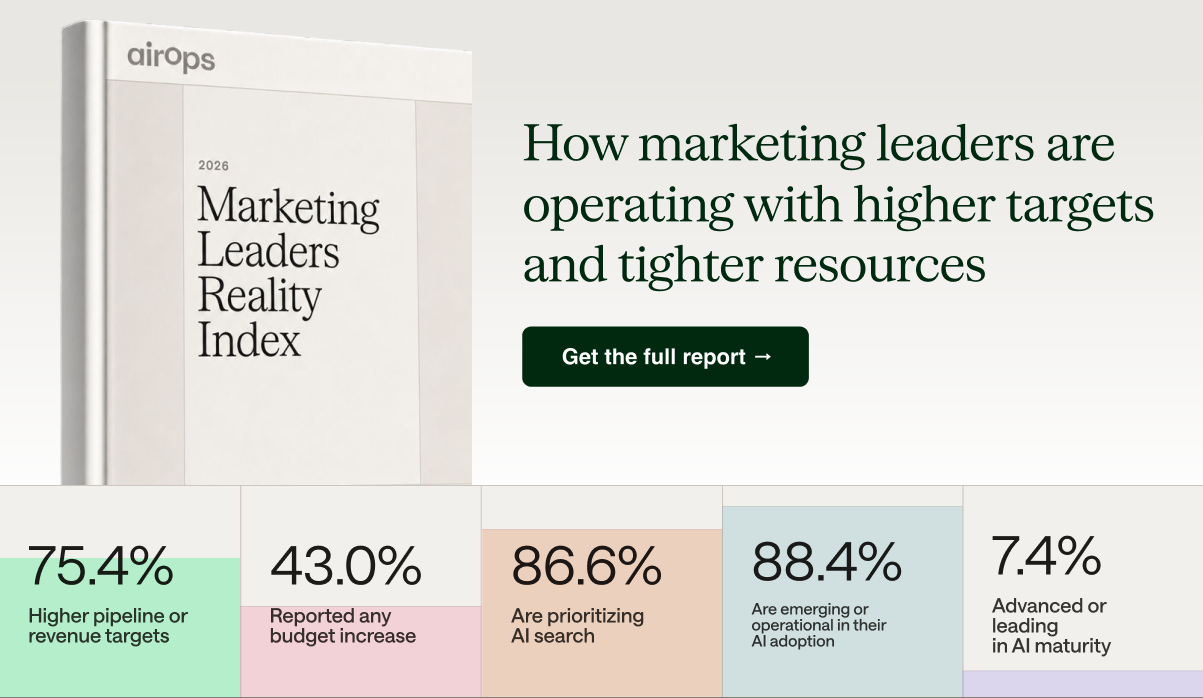
Growth targets are rising faster than the resources behind them, forcing marketing teams to make critical budget decisions without a credible view of how peers are responding.
AirOps surveyed 300+ CMOs and VPs to reveal how leaders are reallocating budgets and closing capability gaps as pressure grows to deliver more pipeline with limited support.
- Compare how peers are responding to higher targets, now affecting 75.4% of marketing leaders across the market.
- Build a stronger budget case using the reality that only 43.0% received more funding.
- See why 86.6% prioritize AI search while just 23% feel confident measuring its impact.
The report lets you compare your growth targets and available resources against responses gathered directly from 300+ marketing leaders.
You’ll immediately see whether your performance gap starts with execution or a plan that was under-resourced from day one.
Get the Marketing Leaders Reality Index.
📺 Your TV benchmark just lost its denominator
Today, YouTube starts counting a public view from the first frame of playback. No minimum watch time, across long-form, live streams and Shorts. The old definition survives in analytics as engaged views.
Anyone who has defended a TV budget in a channel review knows what happens next. Someone pulls a slide comparing cost per view on video against cost per reach point on TV, and video suddenly looks far more efficient than it did in July. Nothing about the audience changed. The denominator did.
Freeze your baselines before the series breaks
Archive your trailing twelve months of video efficiency metrics this week, tagged with the old counting method. Anything computed after today sits in a different series.
Skip it and your rolling twelve-month average silently blends two definitions, producing a trend line that looks like improvement and is an accounting change. The archive takes an hour.
The timing matters more than usual this year, because a clean pre-peak read is the only one you get. Tatari surveyed TV advertisers and found 54% planning to launch holiday messaging before mid-November, the runway that let Knix test into a spot driving 9,000 site visits in five minutes at a 70% lower CPA. You can see how Tatari can help you scale TV for BFCM.
Move cross-channel comparisons to a time-based denominator
Reach counts were never really comparable across TV and digital video, but they were stable enough to argue about. That stability is gone on one side.
Shift any TV-versus-video efficiency comparison onto something both channels can express honestly: completed views, seconds of attention delivered, or incremental conversions per dollar. The last one is the only version that survives contact with a CFO.
You can build this manually with matched-market holdouts and a clean pre-period. It is slower and demands discipline about spend levels, but it produces the same class of answer.
Audit the pitches you receive this quarter
Vendors selling video inventory will refresh benchmark decks over the next sixty days, and some of those numbers will carry the new counting method without a footnote.
Three questions to ask on every deck between now and Q4:
- Which view definition produced this figure, and on what date range
- Is the comparison set computed on the same definition
- What does the equivalent engaged view number look like
A vendor who cannot answer the third question quickly is quoting a number nobody examined.
The change itself is neutral. Consistency across formats is reasonable for a platform to want. The risk sits in the reporting habits built on the old number, and those are about to produce a confident wrong answer in someone's Q4 planning meeting.
📊 Meta and Google hand more ad decisions to AI
Meta and Google are both pushing AI deeper into campaign management, but from different directions. Meta wants AI analyzing what is already running, while Google is giving advertisers more ways to test AI-driven changes before committing.
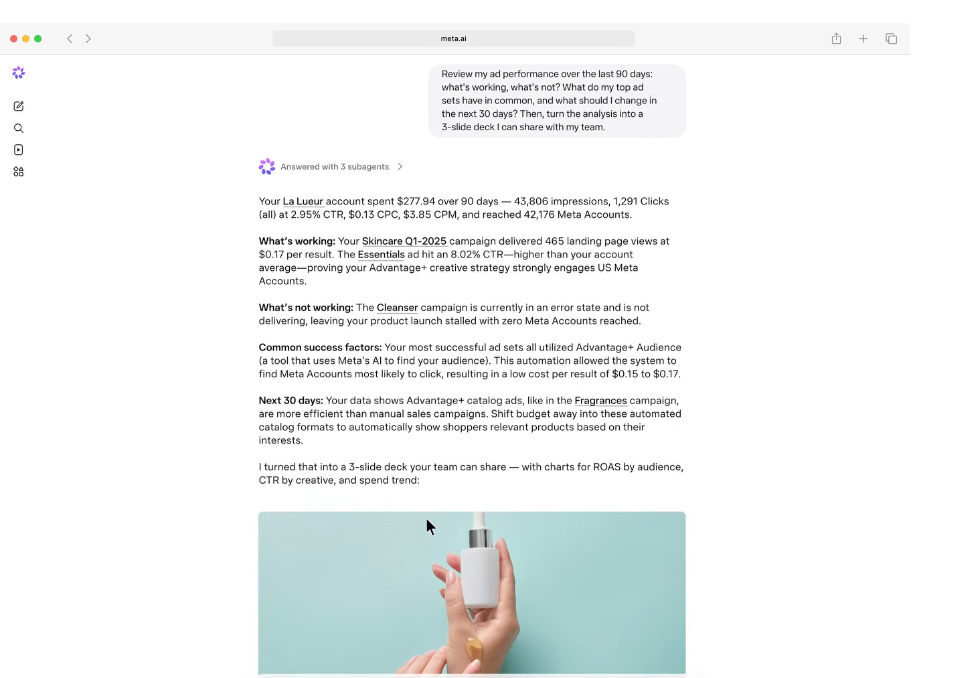
The Breakdown:
Meta AI becomes an ad analyst: Advertisers can connect Meta Ads and Google Workspace, then ask Meta AI to analyze audiences, creative and budgets, recommend optimizations, and identify ads losing traction.
Meta automates the reporting layer: Campaign analysis can be turned directly into decks, documents and spreadsheets, while recurring tasks can automatically run the same performance reviews on a schedule.
Google expands AI Max testing: Starting in September, advertisers can A/B test different budgets and ROI targets across multiple Search campaigns while keeping brand and location controls enabled.
Google lets advertisers forecast first: Performance Planner can model how bidding or budget changes may affect campaigns, then advertisers can apply Google’s recommended changes directly with one click.
Ad platforms are moving AI from campaign setup into the decisions that happen afterward. The shift is toward a loop where AI analyzes performance, proposes the next move, tests it, and increasingly handles the reporting around it.
🎥 Ad of the Day

What Works:
Event Creates Urgency - The oversized “12.12” immediately anchors the creative to a shopping moment, while the sale framing gives viewers a clear reason to act now rather than later.
Bundle Shows Value - Showing the full skincare lineup together makes the promotion feel substantial, while the open-box composition helps shoppers instantly understand they are getting a complete routine.
Discount Drives Attention - The 45% discount badge and double-voucher callout create strong offer framing, adding perceived savings without distracting from the product range or weakening visual hierarchy.
For tentpole sales, make the event date the primary hook, show the full product value visually, then reinforce urgency with one unmistakable discount cue.
Advertise with Us
Wanna put out your message in front of over 50,000 best marketers and decision makers?
We are concerned about everything DTC and its winning strategies. If you liked what you read, why not join the 50k+ marketers from 13k+ DTC brands who have already subscribed? Just follow this.
At ScaleUP, we care about our readers and want to provide the best possible experience. That's why we always look for ways to improve our content and connect with our audience. If you'd like to stay in touch, be sure to follow us EVERYWHERE🥰
Thanks for your support :) We'll be back again with more such content 🥳