
Nobody answers your ad comments
💬 Creator ads collect buyer questions in the comments during BFCM, and unanswered ones cost sales on your highest-spend day, Media Buyer Index of the week, and more!


Howdy readers 🥰
In this newsletter, you’ll find:
💬 Your creator ads are collecting questions nobody answers
📊 Pinterest and YouTube are leading returns, while TikTok quietly lost its edge
🏆 Ad of the day
If you’re new to ScaleUP, then a hearty welcome! You and 50k+ CEOs, CMOS, and marketers have reached the right place. Let’s get into it, shall we? Oh! Before you forget, if someone forwarded this newsletter to you, don't forget to subscribe to our newsletter so you never miss out!
Together with Omnisend
Still Hand-Holding AI Through Your BFCM Prep?
If you’re still copying reports into AI and explaining what they mean, the time savings disappear before you’ve made a single campaign decision.
Omnisend’s free BFCM AI playbook gives you twelve detailed prompts to get answers from your store’s data without starting every question from scratch.
Find last year’s offers worth repeating and buyers who haven’t returned. Check for deliverability warning signs before you increase sending volume, while there’s still time to address them.
Omnisend connects with Claude or ChatGPT, so you can analyze performance and create campaigns in the same conversation. Put those findings into a campaign calendar you can actually work from.
New to Omnisend? Its email and SMS platform serves 150,000+ ecommerce brands, and free migration takes up to five business days.
Start while there’s time to use what you learn. You’ll have more room to test your campaigns before the BFCM rush.
💬 Your creator ads are collecting questions nobody answers
A Partnership Ad runs from the creator's handle, so the comments land on the creator's post. During Black Friday week, that post fills up with buying questions: "Does it ship before Christmas?" "Is this safe for sensitive skin?" "Does the code work on bundles?"
The creator is busy with ten other brands. Your team can't see the thread. Each unanswered question sits in front of every future viewer of an ad you're paying peak prices to run.
Coordinating replies across a dozen creators usually happens in scattered DMs. Insense brings agreements, approvals, and payments into one place, with campaign updates in Slack, Claude, or ChatGPT, so you can check every collaboration's status in a single message instead of chasing replies.
Brands save 40+ hours on creator operations. You can book a free strategy call by October 30th and get $200 toward your first campaign.
Step 1: Agree on who answers before launch
Add a comment clause to every creator agreement:
- The creator checks comments twice a day during the ad flight.
- The creator replies to product questions using your approved answers.
- Anything about orders, refunds, or complaints gets passed to your support team within 12 hours.
The twice-daily and 12-hour figures are my judgment. Pay a small add-on for it, since it's real work during the busiest weeks.
Step 2: Hand over an answer sheet
Give each creator ten approved answers covering shipping cutoffs, sizing, ingredients or materials, returns, and how the discount works. Update the shipping answers as each holiday cutoff passes.
Step 3: Pin the most common answer
Ask the creator to pin a comment answering the top question, usually delivery timing in November. One pinned answer can save dozens of replies.
Step 4: Read comments as data
Every week, collect the questions from your top-spending creator ads. Repeated questions show what your ad and product page fail to explain.
If "does it come in other colors?" keeps appearing, the next creator brief should show the color range on screen.
Step 5: Set a hide policy
Agree in advance which comments the creator may hide: spam, abuse, and links to competitors. Honest negative comments should stay and get an answer, because a visible fix builds more trust than a clean thread.
What to track
- Unanswered product questions per ad, checked weekly
- Average reply time
- Conversion rate on ads with active replies against ads without
Write the ten answers and add the comment clause to every creator agreement that covers November ad usage.
📊 Pinterest and YouTube are leading returns, while TikTok quietly lost its edge
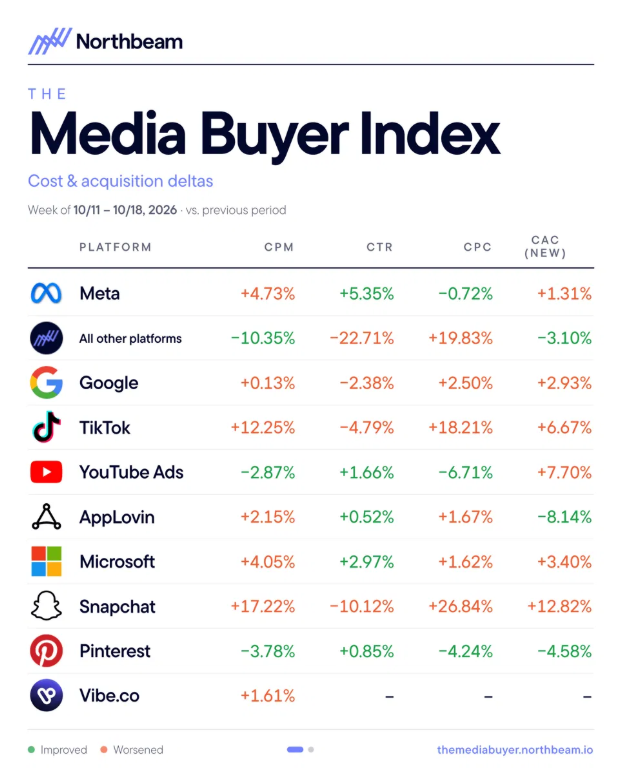
Last week delivered a meaningful rotation in which platforms are worth backing heading deeper into Q4; click costs fell broadly while returns diverged sharply, putting pressure on teams to move budget toward channels that are actually converting rather than those that were working two weeks ago.
The Breakdown:
CPC - Meta, TikTok, YouTube, Snapchat, and Pinterest all saw click costs fall while Google held flat, where CPCs dropped alongside improving ROAS; push budget harder before Q4 auction pressure absorbs the efficiency gain.
CAC - YouTube, Snapchat, Pinterest, and Microsoft all improved sharply while TikTok and Google worsened; YouTube’s CAC recovery after last week’s deterioration is worth acting on; test a 15–20% budget increase and check mid-week before committing further.
ROAS - Pinterest led at +21.95%, and YouTube posted +16.57% while TikTok and Google flatlined; both are posting double-digit returns at minimal budget share; open meaningful test budgets on both before Q4 auctions reprice the opportunity.
Meta holds 55.94% of spend with +3.98% ROAS and growing share, a third consecutive week of positive signals making it the lowest-risk Q4 scaling case on the board.
Pinterest at 0.48% posted +21.95% ROAS, and YouTube at 2.76% posted +16.57%, both severely underfunded. Move budget from TikTok, where ROAS turned negative, into Pinterest and YouTube this week before the window closes.
🎥 Ad of the Day
What Works:
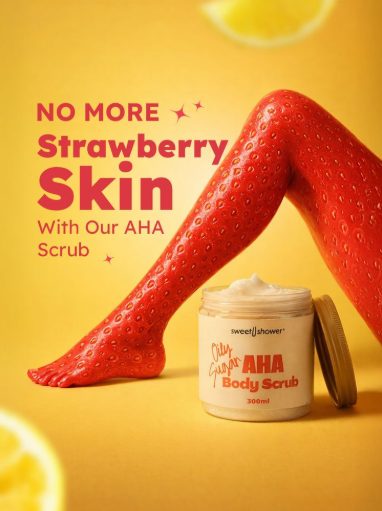
Visual Metaphor Hooks - The strawberry-textured legs make “strawberry skin” instantly literal, creating a strong pattern interrupt while helping shoppers understand the problem before they process the product.
Problem Solution Lands - “No more strawberry skin” states the pain point directly, while the AHA scrub sits beside the visualized problem, creating a simple problem-to-solution hierarchy with low cognitive load.
Color Builds Memory - The red-on-yellow palette feels bold, warm, and highly scroll-stopping, while the product jar stays clearly visible enough to preserve branding recall and product recognition.
Turn the customer’s pain point into an exaggerated visual, then place the product beside it as the fix. That makes problem awareness and solution mapping almost instant.
Advertise with Us
Wanna put out your message in front of over 50,000 best marketers and decision makers?
We are concerned about everything DTC and its winning strategies. If you liked what you read, why not join the 50k+ marketers from 13k+ DTC brands who have already subscribed? Just follow this.
At ScaleUP, we care about our readers and want to provide the best possible experience. That's why we always look for ways to improve our content and connect with our audience. If you'd like to stay in touch, be sure to follow us EVERYWHERE🥰
Thanks for your support :) We'll be back again with more such content 🥳