
Your deliverability blind spot
📉 Microsoft quietly removed a spam trap signal in July, nine weeks before your biggest send of the year, Media buyer index of the week, and more!


Howdy readers 🥰

In this newsletter, you’ll find:
📉 The deliverability signal that quietly disappeared
📊 YouTube quietly became the most efficient major platform, and most budgets haven't noticed
🏆 Ad of the day
If you’re new to ScaleUP, then a hearty welcome! You and 50k+ CEOs, CMOS, and marketers have reached the right place. Let’s get into it, shall we? Oh! Before you forget, if someone forwarded this newsletter to you, don't forget to subscribe to our newsletter so you never miss out!
Together with Levanta
Your Best Holiday Creators Are Choosing Brands Now
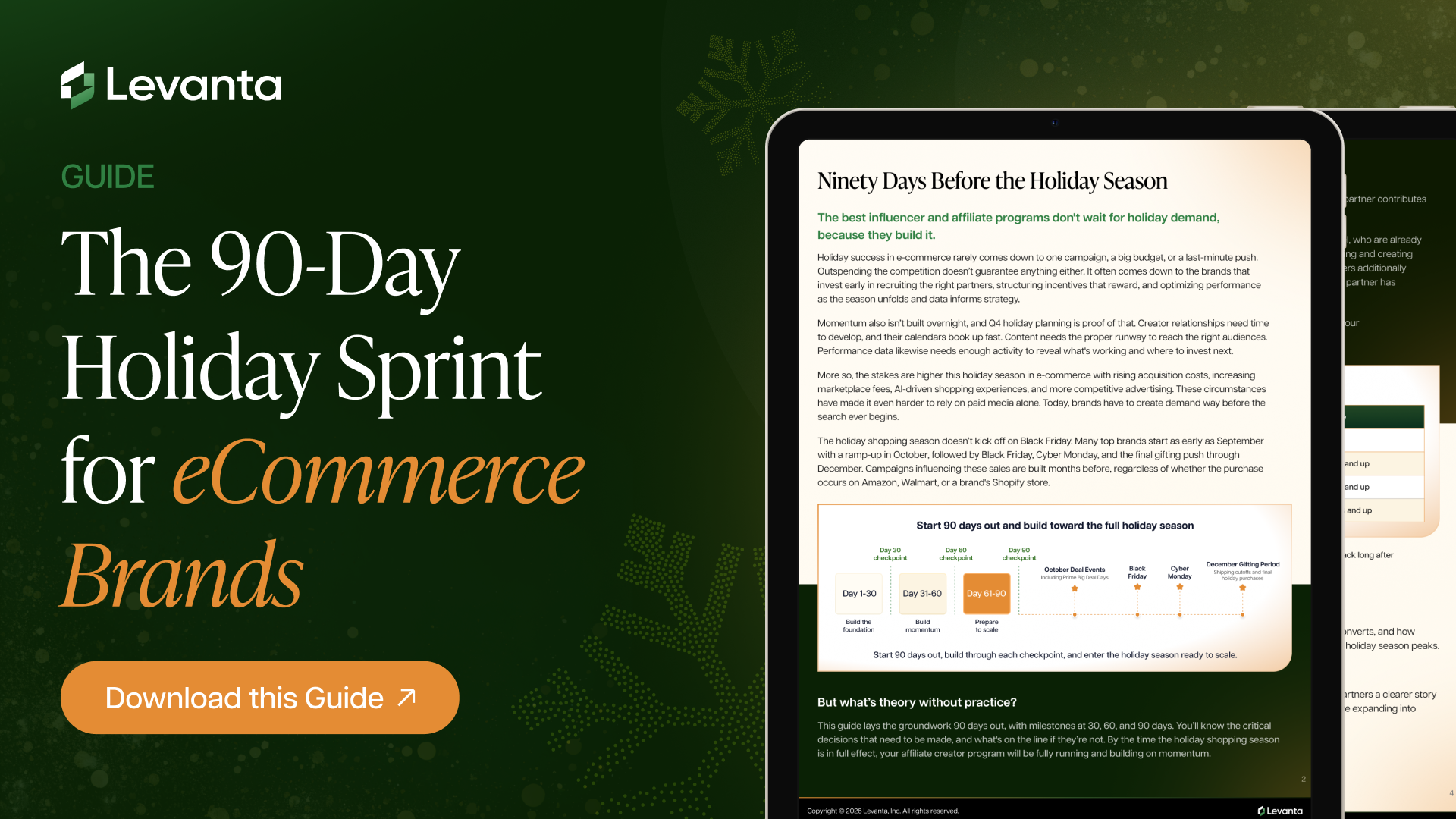
Holiday performance is often decided before the promotion goes live. Creators commit to brands offering attractive economics and strong audience fit, so delayed outreach leaves your team competing for whatever attention remains.
Levanta built The 90-Day Holiday Sprint to turn that shrinking window into measurable momentum. Inside, you’ll learn how to:
- Set commissions around customer lifetime value, protecting margin while attracting stronger partners.
- Recruit with proven products that give creators better conversion potential.
- Use 30, 60, and 90-day checkpoints to identify winning relationships before seasonal budgets rise.
A 90-day runway gives you time to see which creators convert before holiday budgets climb. That evidence makes every commission increase easier to defend.
Don’t wait until November to build the creator program you will wish you already had. Your 90-day countdown starts now.
📉 The deliverability signal that quietly disappeared
Microsoft pulled trap hit counts from its SNDS Data Report on July 22, removing a signal neither Google nor Yahoo ever offered.
If your team relied on that number to catch a bad list segment before it torched your sender reputation, that early warning is gone, nine weeks before Black Friday.
Most teams don't notice a monitoring signal is missing until the thing it caught shows up somewhere worse.
A spam trap hit means part of your list contains addresses that shouldn't be getting mail, dead accounts recycled into traps or scraped addresses never opted in.
Left uncaught, that segment erodes your sender score across all three major providers, not just the one that stopped reporting it.
Rebuild the visibility Microsoft's tool used to give you
Google Postmaster Tools still reports spam rate, reputation, and authentication status, on primary domains only, as a rolling multi-day average, not the trap-specific signal Microsoft removed.
Cross-reference the two remaining sources you have. Pull spam complaint rate trend from Postmaster Tools weekly rather than checking only when something looks wrong, and treat any unexplained jump as the proxy signal you no longer get directly.
Audit list hygiene before volume ramps, not during it
Nearly one in six ecommerce brands earns at least 30% of annual orders during the holiday period, meaning send volume then can run several times a normal month's baseline. A segment borderline in October becomes the one that tips your complaint rate over threshold in November, exactly when the cost is highest.
Run a full suppression pass now: hard bounces from the last two sends, any address with zero opens across your last ten campaigns, and anything flagged by your platform's own engagement scoring. Removing that segment before volume increases is cheaper than discovering the problem after a BFCM send lands in spam.
Choose infrastructure that carries this monitoring for you
Auditing deliverability signals manually across three separate provider dashboards is a real ongoing job, not a one-time cleanup, and it's exactly the kind of overhead that becomes a liability the week before your biggest sales period.
A platform managing that monitoring as part of the send infrastructure itself, rather than leaving a team to reconstruct visibility Microsoft just took away, is worth weighing against whatever platform currently owns your list.
One agency's pre-BFCM migration to Omnisend closed with a client generating $113K over the holiday period, matching the prior year's revenue despite the switch. You can read the full story.
The signal disappearing didn't create the risk. It just removed your warning that the risk was building.
📊 YouTube quietly became the most efficient major platform, and most budgets haven't noticed
Last week’s media buyer index produced a mixed but readable signal set, CAC improved on several high-spend platforms while returns fragmented across the board, creating a clear divide between channels worth scaling and channels worth trimming heading into the final stretch of August.
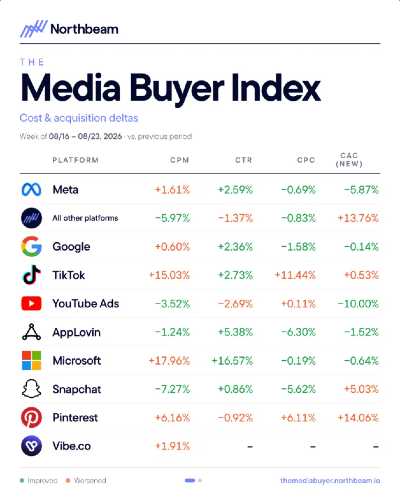
The Breakdown:
CPC - Meta and Google saw click costs fall while TikTok and Pinterest pushed higher, where CPCs dropped alongside improving CAC like Meta and Google, test a controlled budget increase this week before auction pressure rebuilds and closes the window.
CAC - Meta, Google, YouTube, and Microsoft all improved while Snapchat and Pinterest worsened sharply, Pinterest's +14.06% CAC spike makes it an immediate pause candidate; hold all spend increases there until costs stabilize and CvR shows a recovery signal.
ROAS - YouTube led at +8.42% and Snapchat posted +5.26% while Pinterest collapsed at -19.59% and Meta slipped to -0.35%, shift incremental budget toward YouTube now where CvR and ROAS are both moving in the right direction simultaneously.
Meta shed share to 54.47% with -0.35% ROAS despite improving CAC, he efficiency gains aren't reaching the return line yet, so hold Meta's budget flat rather than scaling into a signal that hasn't fully confirmed.
YouTube at 3.15% posted +8.42% ROAS and +8.94% CvR in the same week, making it the clearest scaling case on the board. Move budget from Pinterest into YouTube this week and review mid-cycle before committing further.
🏆 Ad of the day

What Works:
Scale Creates Impact - The oversized sneaker dominating the city street creates an immediate pattern interrupt, giving the product huge thumb-stop power while making comfort feel larger than life.
Environment Adds Meaning - Placing the shoe directly over an urban walking route connects the product to everyday movement, strengthening message-market fit for consumers who spend long hours on their feet.
Copy Reinforces Benefit - “Sink into comfort. Conquer every step.” pairs a sensory promise with an active outcome, helping the creative sell both cushioning and confidence without adding cognitive load.
Take the core product promise and exaggerate it visually. If comfort is the benefit, make the product feel powerful enough to dominate the entire environment.
Advertise with Us
Wanna put out your message in front of over 50,000 best marketers and decision makers?
We are concerned about everything DTC and its winning strategies. If you liked what you read, why not join the 50k+ marketers from 13k+ DTC brands who have already subscribed? Just follow this.
At ScaleUP, we care about our readers and want to provide the best possible experience. That's why we always look for ways to improve our content and connect with our audience. If you'd like to stay in touch, be sure to follow us EVERYWHERE🥰
Thanks for your support :) We'll be back again with more such content 🥳